The killings and the search
Ariana and Cruz, 55, were killed on October 19, 2026, the same day the girl was last seen. Diario de México reported that searchers found Cruz's body on Wednesday, October 21, and located Ariana's on Friday, October 23, in a grassy area some distance away.
The Chiapas prosecutor's office reported that Cruz suffered fatal blood loss after a sharp object severed major blood vessels in her neck. Ariana died by strangulation. The forensic findings also documented sexual assault, injuries inflicted after death, severe head trauma and wounds associated with struggling and defending herself.
Before Ariana's funeral on the morning of Saturday, October 24, residents protested outside Ostuacán's municipal presidency, according to Diario de México. They accused Mayor Víctor Manuel López Jiménez of failing to support the search promptly and complained that official agencies had claimed credit for finding the victims when neighbors had made the discovery.
Authorities identified the suspects as Armando "N," known as El Melo, and Andrés "N," known as El Cera. The men fled after the killings and were arrested soon afterward. Prosecutors describe their involvement as "fully established."
Chiapas Attorney General Jorge Luis Llaven Abarca said the motive was personal revenge but did not publicly explain what prompted it. La Jornada separately cited a security source who linked the killings to a cattle dispute. Llaven Abarca also said Andrés had a criminal record for robbery with violence in 2023 and was addicted to psychoactive substances.
A crowd overwhelms police
As people gathered outside the town hall, Governor Eduardo Ramírez issued an urgent appeal on social media, asking residents to let the law take its course. He warned that vigilante justice "does not restore peace and only brings more pain and legal consequences for innocent people." Neither that appeal nor the police guarding the suspects prevented the attack.
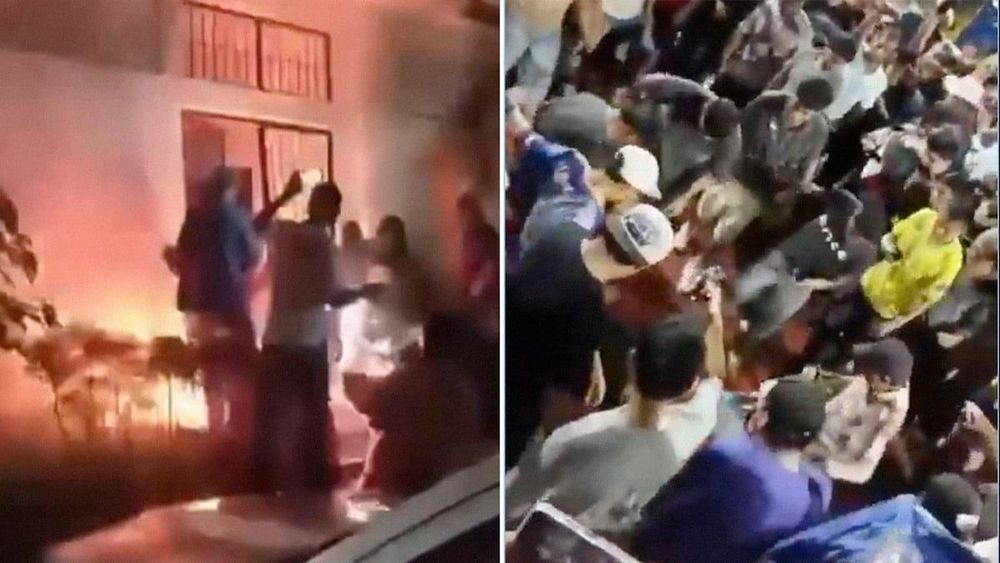
According to reporting by Reforma republished by Vanguardia, residents used firecrackers as they entered the police station, pulled the two men out and set the building's interior on fire. Others used motorcycles to block routes into and out of town, and residents cut the electricity, leaving the center dark.
The mob beheaded Armando in the central square and left Andrés gravely injured. The lynching occurred in the ejido Xochimilco Viejo, in Ostuacán, a town with just over 3,000 residents.
Prosecutors have opened a homicide investigation into Armando's death. Andrés faces a possible 100-year prison sentence, the maximum punishment Llaven Abarca is seeking in the double femicide case.
Impunity and limited police capacity
For Matilde Domínguez, a violence expert at the Autonomous University of Mexico (UNAM), the case illustrates "a vortex in which the system itself is unable to contain violence through any means other than violence itself." She says authorities fear "social unrest" and describes access to justice as institutionally out of reach, with violence becoming a means of obtaining it. In her view, the state should regulate that violence.
Manuel Pérez Aguirre of the College of Mexico A.C. (Colmex) points to both actual and perceived impunity, alongside the limited capacity of municipal police. He calls those forces "the most fragile link in Mexico's security chain." Across the vast majority of Mexico's nearly 2,500 municipalities, he says, departments have only 20 or 30 officers divided among shifts, leaving roughly 10 or 12 to protect large populations at a time.
Both researchers also identify entrenched cultural dynamics behind the use of lynching in rural communities and on the outskirts of cities in central and southern Mexico.
Pérez Aguirre cautions that mob attacks do not always follow a confirmed crime: "an actual offence is not always committed; many times it is the population acting on its own beliefs." Accusations that precede lynchings range from theft and kidnapping to murder, and sometimes rest only on suspicion.
What the violence data show
The NGO Causa en Común has documented at least five other lynchings in Mexico in 2026: two in the State of Mexico and one each in Aguascalientes, Baja California Sur and Tlaxcala. Its "Galería del Horror" report covering 2025, published in May 2026, recorded 29 completed lynchings and 66 attempts. Those incidents were included in a tally of 4,783 acts of extreme violence involving at least 6,707 victims, compiled from 4,065 news reports.
Longer-term research also documents the scale of mob violence. The Center for Security Studies at ETH Zurich recorded 2,818 lynchings across Latin America from 2010 through 2019; Mexico accounted for 30% of them.
The Linchamientos en México database, developed by researchers including Sandra Ley of Tec de Monterrey alongside Tulane University and UC Davis, contains 2,032 events from 2009 through 2022. It records more than 100 incidents in each year from 2019 through 2022. At least a quarter of the lynchings were lethal, and authorities intervened in only slightly more than half of the cases.
Violence against women presents another persistent problem. Mexico's Executive Secretariat of the National Public Security System recorded the murders of 28 women in Chiapas from January through September 2026. Measured per 100,000 women, the state's rate was the country's 10th highest and slightly above the national average.
Chiapas had the lowest reported prevalence of violence against women among Mexican states in INEGI's 2021 survey on household relationships. Still, 48.7% of women age 15 and older reported experiencing violence at some point in their lives, while 26.9% said they had experienced it during the preceding year.
On the day Llaven Abarca identified revenge as the motive in Ariana and Cruz's deaths, state authorities announced several other cases: an aggravated sexual abuse charge against a man in Sabanilla; arrests of two men in Escuintla and Tuxtla for aggravated child sexual abuse; a detention in Chiapilla for aggravated domestic violence; and an arrest in Siltepec for aggravated sexual abuse.
Remembering Ariana
Family photographs show Ariana celebrating her ninth birthday, eating ice cream and embracing the grandmother who appears beside her in so many pictures. Salomé Cruz, Miriam's niece, wrote on Facebook that Ariana had dreamed of working in the countryside.
"Why kill a girl who was only just beginning to live her life?" Salomé asked.
The missing-person bulletin recorded a different kind of portrait: a 12-year-old with a dark complexion, a slim build and brown hair, weighing 32 kilograms and standing 1.4 meters tall. It described a small, straight nose and thin lips. Under distinguishing marks, it listed none.