Funeral services in Mexico City
Cárdenas died at Hospital Ángeles Metropolitano in Mexico City's Roma Sur neighborhood. As of October 29, his family and Mexican authorities had not released an official statement identifying the cause of death.
His remains were taken Wednesday night to the Panteón Francés de San Joaquín in the Miguel Hidalgo borough. Relatives, friends and public figures were expected to gather there Thursday to remember the civil engineer whose political career helped build an opposition to the long-dominant Institutional Revolutionary Party (PRI).
Recognition from allies and rivals
President Claudia Sheinbaum focused her tribute on the movement Cárdenas led during the disputed 1988 presidential election. She said it gave expression to millions of Mexicans' demands for change and helped transform the country's politics. Cárdenas "should have been recognized as president," she said, describing that election day as the beginning of Mexico's democratic transformation.
Former President Andrés Manuel López Obrador honored him as a forerunner of the modern democratic opposition. Recognition also came from politicians who had opposed him, including former President Vicente Fox, his rival in the 2000 presidential race.
Fox wrote: "we were political adversaries but something bigger united us: the conviction that Mexico deserved complete democracy." Other tributes came from PAN president Jorge Romero Herrera, PRI president Alejandro Moreno, Movimiento Ciudadano leader Jorge Álvarez Máynez and Mexico City head of government Clara Brugada.
A career that challenged the PRI
Born in Mexico City on May 1, 1934, Cárdenas was the son of former President Lázaro Cárdenas del Río and trained as a civil engineer. His first political offices were within the PRI: during 25 years in the party, he represented Michoacán in the Senate and governed the state from 1980 to 1986.
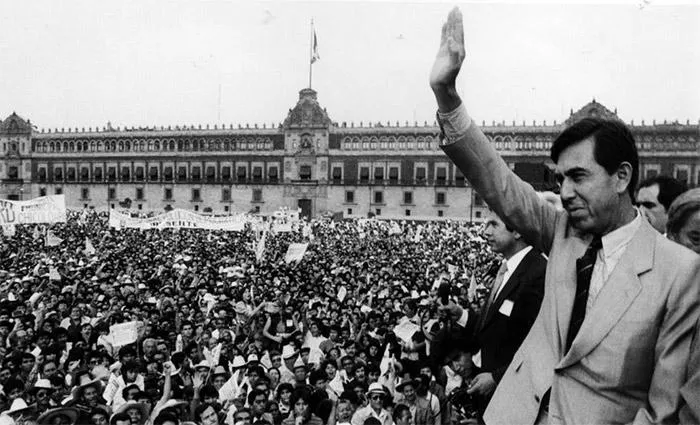
By 1987, he was pressing for change inside the party. Together with Porfirio Muñoz Ledo and Ifigenia Martínez, he led the Democratic Current, which sought more open politics and changes in how candidates were chosen. After breaking with the PRI, he headed the National Democratic Front's presidential ticket in 1988.
The official result named Carlos Salinas de Gortari the winner, but allegations of fraud made the election a focus of opposition protest. The mobilization reinforced demands for electoral reform and helped organize political forces outside the party that had ruled Mexico for decades.
Cárdenas helped establish the PRD on May 5, 1989. It became a major opposition party, bringing together groups on the left, social movements and others seeking an alternative to the existing political system. His unsuccessful presidential bids in 1994 and 2000 helped strengthen that organization.
Between those campaigns, he won a landmark election in the capital. In 1997, with 48.09 percent of the vote, Cárdenas became the first head of government of the then Federal District chosen by direct popular vote. The victory opened the capital's government to a change in party control.
Later breaks with the left
As López Obrador and other leaders became more prominent on the left, Cárdenas remained identified with electoral democratization and the defense of Mexico's energy sovereignty. He also broke with former political allies.
In November 2014, he quit the PRD over disagreements with its leadership and declared himself an independent. The Associated Press reported that his departure was tied to the party's control of Guerrero when 43 students disappeared there. According to the AP, he later distanced himself from longtime ally López Obrador after López Obrador became president in 2018.
The tributes to Cárdenas thus brought together former allies and rivals at a time when Mexico's left holds the presidency through Morena, rather than through the party he helped create.
Public work continued in 2026
Cárdenas remained involved in public life during his final year. The Instituto Politécnico Nacional awarded him an honorary doctorate in January. In February, he presented his book "Por una democracia progresista" at the Palacio de Minería during the Feria Internacional del Libro.
In March, Sheinbaum announced his appointment as honorary president of the Consultative Commission on Oil at Petróleos Mexicanos (Pemex). The commission was established to examine the hydrocarbons industry's trends and prospects and advise on strategic decisions. At its initial work sessions in April, Cárdenas advocated a long-term plan to turn Pemex into an energy company, continuing his engagement with the state's management of energy resources.
His public appearances became less frequent in the months that followed. The last documented in-person appearance was July 10 at the Michoacán Congress, where he attended a tribute to his mother, Amalia Solórzano Bravo. His final public interview aired August 10 on "Entre Amigos con Mancera," the podcast hosted by former Mexico City mayor Miguel Ángel Mancera.
For health reasons, he canceled an inaugural lecture scheduled for October 22 at a Universidad Veracruzana congress in Xalapa.