Evidence of a burial deposit
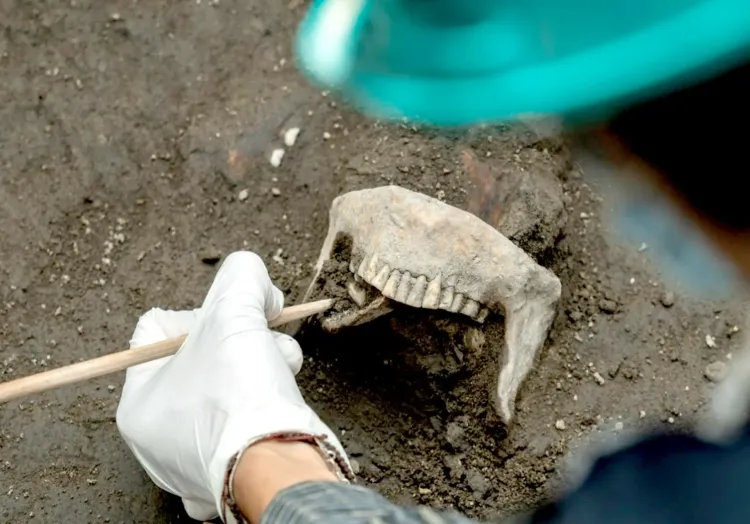
Rail crews encountered the first bones on September 17, 2026, while building an embankment for new tracks. A salvage archaeology team from Mexico's National Institute of Anthropology and History (INAH), led by Víctor Francisco Heredia Guillén, was already monitoring the work.
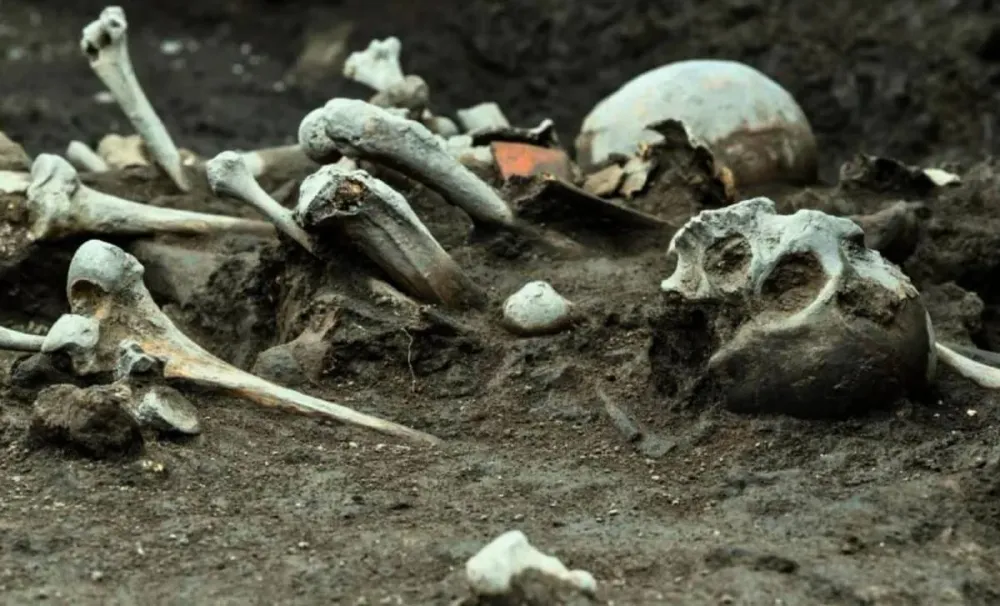
Skulls, jaws, pieces of femurs and hip bones, ribs and teeth were recovered about 1.4 meters (4.6 feet) below ground. Excavation farther down revealed bones heaped together rather than lying in the positions of complete skeletons. Fieldwork supervisor Josué Castillo Sánchez considers that arrangement evidence of a possible ossuary: a place where remains were collected after decomposition.
The types of bones present offer another clue. Abril Machain Castillo, the physical anthropologist who directed their removal, identified a concentration of skulls and long bones, which tend to endure better than smaller, irregular skeletal elements. Those smaller bones were less prominent in the deposit.
Machain explained that communities sometimes made room for new burials by reopening older graves and moving selected bones to another location. The Buenavista collection is consistent with that practice, although researchers have not established whether that is how this deposit formed.
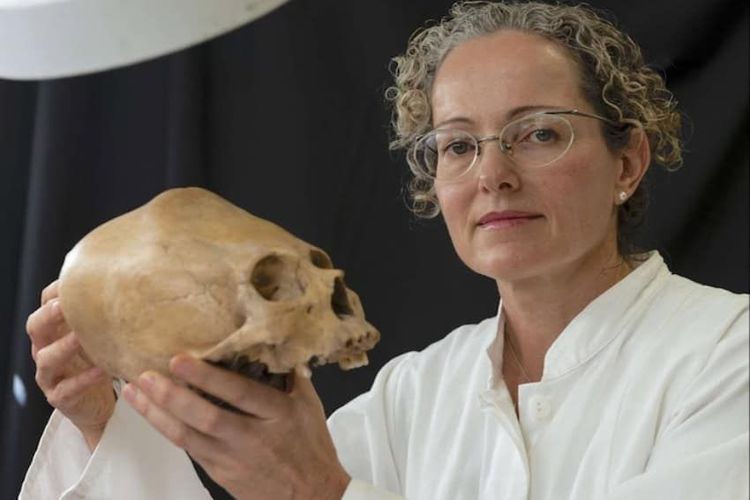
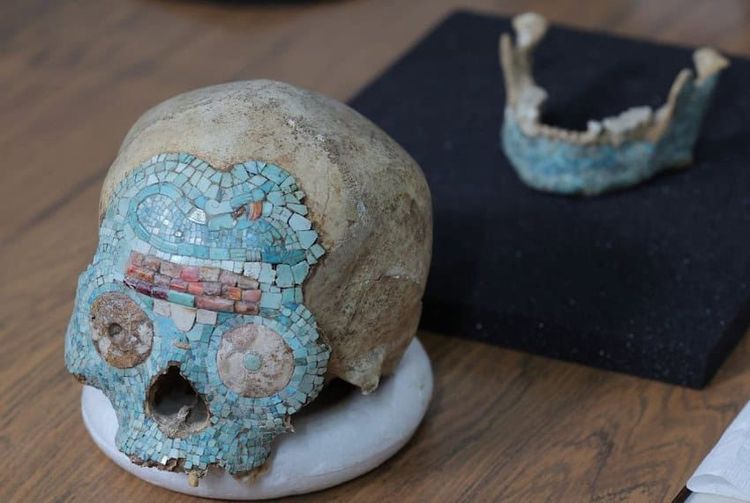
Two skulls bear evidence of cranial modification, but the method used to alter their shape remains undetermined. Some larger bones, including radii, shinbones and hip bones, are relatively well preserved. The individuals' identities, ages at death and sex are still unknown.
Artifacts offer clues, not a firm date
Alongside the remains, archaeologists found Aztec III pottery, a tradition dated to 1350–1520. The vessels include plates, cooking pots and salineras used to extract salt from ancient Lake Texcoco, the shallow lake on which the Aztec capital stood.
The deposit also contained two figurines and seven miniature spindle whorls. Among the polished stone tools were four fragments of hand stones for grinding corn and other foods. Most of the small blades recovered were green obsidian, provisionally traced to the Sierra de las Navajas in Hidalgo.
INAH announced the discovery on November 4, 2026, identifying two possible date ranges: the Late Postclassic period, AD 1200–1519, or the period of contact with the Spanish, AD 1519–1535. José Manuel Cervantes Pérez, head of the physical anthropology laboratory, also raised a broader possibility: the remains and artifacts could date to the final years before the conquest or to the colonial period of 1535–1821.
Mexico City has yielded other ossuaries associated with contact-period or colonial burials. This deposit stands out for the quantity of pre-Hispanic objects accompanying the bones. Their presence does not establish a burial date, however, because pottery produced before the conquest could have remained in use or entered the ground later.
Specialists will examine the bones and archaeological context to refine the dating. The remains and artifacts have been sent to physical anthropology, stone-tool and ceramics laboratories in Tula de Allende and Tepeji del Río de Ocampo, Hidalgo. Cleaning and restoration will precede analysis, including studies of age, sex and the skull modifications.
The Nonoalco setting
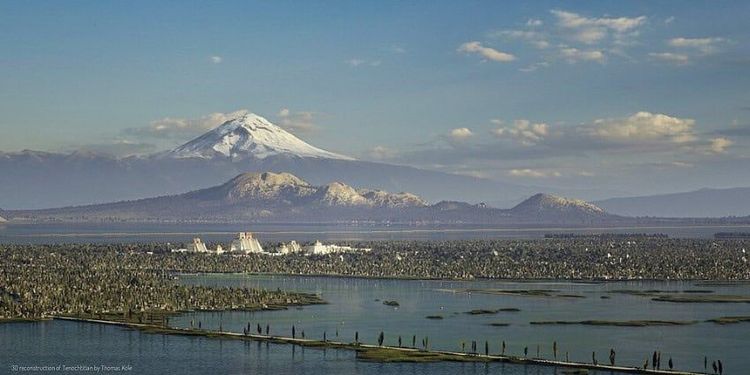
The discovery site falls within the former calpulli, or neighborhood district, of Nonoalco. It was one of 19 pre-Hispanic neighborhoods on the island of Tlatelolco. Researchers hope the deposit will shed light on local treatment of the dead, while Mexico's culture secretary, Claudia Curiel de Icaza, said it raises questions about burial and remembrance during a period of profound historical upheaval.
Tlatelolco had competed with Tenochtitlan, the Aztec capital, before its incorporation into that city in 1473. By the time the Spanish arrived, Tlatelolco was known for the largest market in the Mexica world.
Resistance continued there after Tenochtitlan fell. On August 13, 1521, the last emperor, Cuauhtémoc, was captured and forced to surrender to Hernán Cortés; Tlatelolco was subsequently sacked and destroyed.
The nearby church of San Miguel Nonoalco provides another possible avenue for investigation. Built in the 16th century, it served as a mission chapel for Franciscan friars from the Convent of Santiago Tlatelolco.
Rail construction continues under archaeological oversight
Authorities have reported no construction changes or suspensions resulting from the discovery, according to SDP Noticias. Work continues under the salvage archaeology program's supervision and protocols.
President Claudia Sheinbaum reported on October 31, 2026, that the Mexico City–Querétaro passenger train project was 32% complete. The approximately 230-kilometer line will connect Buenavista station with central Querétaro through six stations. Its average speed is listed at 130 km/h, with a planned journey of about two hours.
Forty-seven trains have been contracted and are being manufactured. Construction is led by the military's Agrupamiento de Ingenieros 'Felipe Ángeles' (SEDENA). The line belongs to a federal program to build roughly 2,500 kilometers of railway with an investment exceeding 700 billion pesos.