From discarded receipts to toys
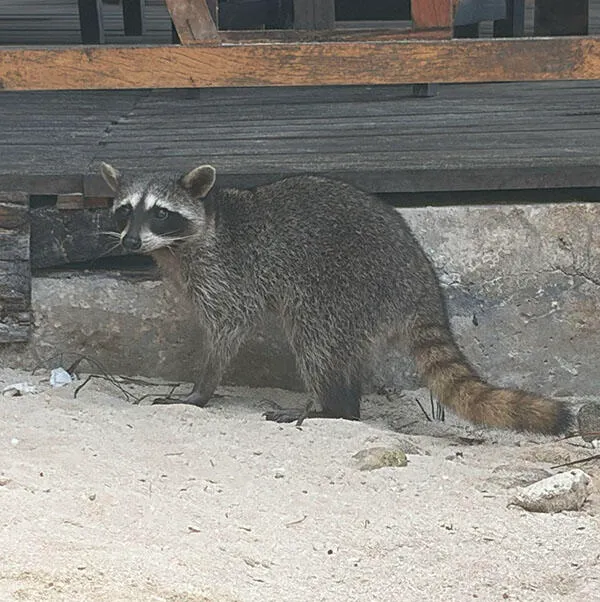
Nessie O'Neil, a biology master's student at Miami University, watched raccoons retrieve paper receipts from the trash, soak them in water and shape them into balls using sand. Over 64 hours of observation, the researchers recorded both the ball-making process and the animals' play.
Of 14 recorded attempts, eight yielded finished balls; the other six failed or stopped before completion. The overall success rate was 57.1%. The animal identified as Juvenile 1 completed six of eight attempts, or 75%, while Juvenile 2 completed two of six, or 33.3%.
The researchers recorded six occasions when the raccoons played with the balls, chasing them, batting them along the ground or toward each other, and rolling them between their forepaws. On one occasion, two juvenile dwarf coatis (Nasua narica nelsoni) joined the two young raccoons.
The peer-reviewed journal Wild, published by MDPI, published the study on August 25, 2026, in volume 3, issue 3, article 33. O'Neil's co-authors are Michelle Szydlowski of Project Dragonfly and Noel Anselmo Rivas-Camo of the Subdirección de Ecología, Cozumel Municipality, Mexico. O'Neil also recounts the discovery in her YouTube video, "I discovered a new behavior in critically endangered Pygmy raccoons."
A family skill, with limits to the evidence
Ohio Daily Brief's account of the research reports that one raccoon taught its family to make and use the balls. This combination of creating an object from another material and transmitting the skill is the basis for describing the finding as material culture.
The researchers also documented a sister performing the entire process on her own. About five days after the first juvenile was taken into rehabilitative care, the second juvenile wet a hamburger wrapper, rolled it against sand and a rock to form a ball, and then played with it.
The first juvenile later died in rehabilitative care. The study identifies malnutrition and exposure to human-derived toxicants as the likely causes. Two siblings had also been lost in the weeks preceding the observations: one from a younger litter of three and another from an older litter of three.
The authors emphasize that these observations alone do not establish a stable cultural tradition. They present the findings as preliminary evidence that social interaction influenced how the raccoons used materials, and call for further behavioral research to determine whether the skill extends beyond this family.
Comparison with another Cozumel site
At a similar tourism site on Cozumel's northwestern end, about 30 kilometers away, researchers saw no ball-making. Young raccoons there had paper waste and fresh water available and were accustomed to people. The study interprets that contrast as supporting a local innovation spread through social exposure, rather than a habit shared across the species.
Regular travel between the sites was highly unlikely, the researchers argue. They cite average home ranges of roughly 97 to 123 hectares and genetic evidence of northern and southern subpopulations with limited connectivity.
Possible uses in conservation
Fewer than 200 pygmy raccoons remain in the wild. The discovery could help conservationists develop science-backed ways to teach healthier feeding behaviors, such as seeking crabs rather than eating tortilla chips and other tourist garbage.
The work may also inform future conservation plans with the Cozumel Municipal Ecology Department.