
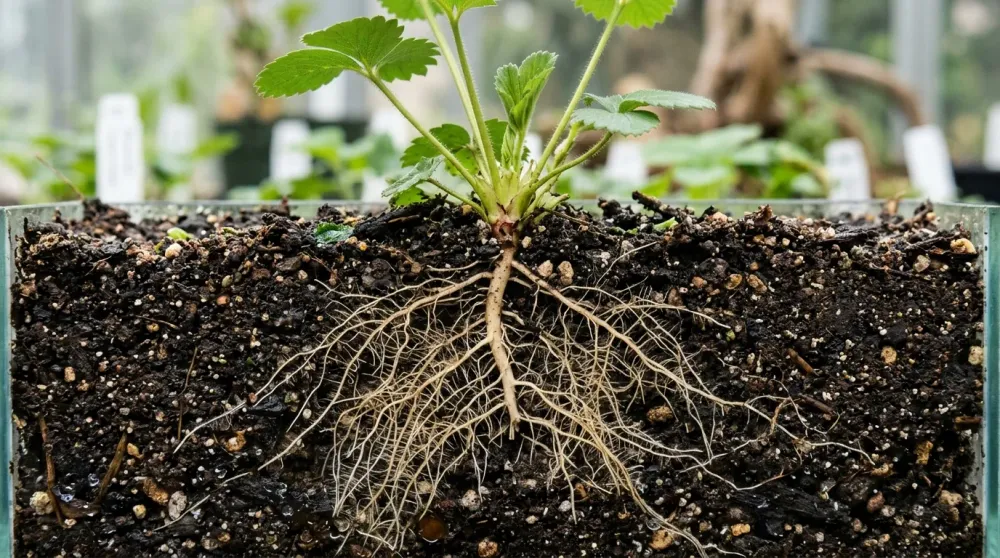
Testing five strains on strawberries
The team tested five bacterial strains on 'Cabrillo' strawberries (Fragaria × ananassa). With reduced fertilization, several treatments increased fresh root biomass, dry root biomass, or both, compared with uninoculated controls. Those controls received either the full fertilizer volume of 150 mL or the reduced volume of 50 mL.
The five strains were chosen from 24 isolates after screening for plant growth-promoting traits. The isolates' capabilities included solubilizing phosphate and zinc and producing indole-3-acetic acid (IAA), siderophores, and ammonia.
Bacteria from a cactus diversity center
The bacteria came from two native cactus species sampled in Zapotitlán Salinas, within Mexico's Tehuacán-Cuicatlán Biosphere Reserve. Hylocereus undatus yielded four strains, while Opuntia pubescens yielded 20.
Using 16S rRNA gene sequencing and MALDI-TOF MS, the researchers identified the isolates as members of Rhizobium, Pantoea/Erwinia, Pantoea, Paenibacillus sp., the Bacillus cereus group, Sphingomonas, and Pseudomonas oryzihabitans.
Zapotitlán Salinas lies in the Tehuacán-Cuicatlán Valley, which joined the UNESCO World Heritage List in 2018 under natural criterion (x). The UNESCO/IUCN evaluation describes the valley as a global biodiversity hotspot and a major center of cactus diversification. At least one species from about 70% of the world's floral families is represented there.
The evaluation also identifies the valley as a global center of agrobiodiversity, with 28 cactus genera and 86 cactus species, including 21 endemic species. It ranks the biosphere reserve that contains the study area among the world's top 0.20% most irreplaceable protected areas for the survival of threatened species.
Other strawberry biofertilizer research
The greenhouse findings add to research on bacterial biofertilizers for strawberries. A 2025 review in Tropical Life Sciences Research concluded that rhizobacteria-based biofertilizers offer a sustainable alternative to chemical fertilizers for the crop. It described growth-promoting mechanisms including nitrogen fixation, phosphorus and potassium solubilization, and phytohormone production in genera such as Bacillus, Azospirillum, Azotobacter, Pantoea, and Pseudomonas.
In a separate greenhouse study published in Agronomy in 2023, Valle-Romero and colleagues tested a consortium of plant growth-promoting bacteria isolated from halophytes. Among strawberries grown with an insoluble phosphorus source, inoculated plants had about 20% more shoot biomass and 32% more root biomass, along with improved photosynthetic performance.
For the cactus-derived bacteria, the Plant Biosystems authors called for further evaluation of their potential use in sustainable, low-input agricultural systems.